

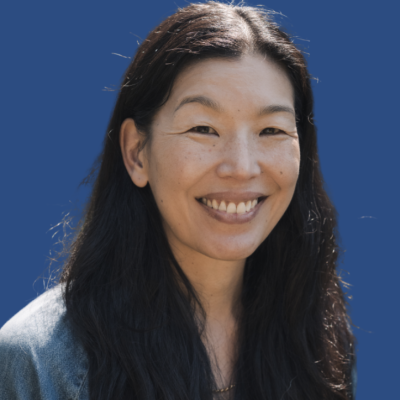
By Ai-jen Poo, Executive Director of Caring Across Generations
We won’t be able to predict when we will become caregivers. Just like we won’t know when we will need the care of others. In the unfolding of life, an accident, a tough pregnancy, a diagnosis of Alzheimer’s and suddenly the future you imagined for yourself flashes before your eyes and then disappears. We don’t know when or how it will happen, but the day will come.
When it happens, we’re rarely ready. I couldn’t have predicted that my grandfather, a man who gave me some of my most joyous memories when he cared for me as a child, would also give me some of my most vivid memories of heartbreak when we had to place him in a nursing home. Motherhood did not unfold the way I had imagined; after years of fertility treatments and miscarriages, I ended up becoming a parent through step-motherhood. I did not foresee my relationship with my mother-in-law, Jo Holt, deepening through care when I first grew to love her a dozen years ago. Today, I am a member of the care team who ensures that her days begin with someone who knew her long before she started losing her memory.
Countless numbers of us are living some version of this.
The Caregiving Generation
There are 130 million of us currently navigating care for people we love. Between Millennials having children, Boomers reaching “Peak 65” at an unprecedented rate, and all of us “sandwiched” between caring for young children and aging or disabled loved ones at the same time, America today needs and gives more care than any other time in history. We even have 5.4 million young people under the age of 18 caring for siblings, parents and grandparents. We’re all in it, but somehow we’re all isolated, and our care is happening in inefficient, and costly ways. It turns out as a nation, we aren’t ready to support all of us who are caregiving, and we’re certainly not ready for what’s to come.
The existing programs that support caregiving have strict income eligibility requirements. Most of us earn just enough not to be eligible, but not nearly enough to pay out of pocket for essential care.
Even if we are eligible for Medicaid or support from the Veterans Administration, it’s often hard to find the right services, especially if you live in a rural or small town community.
Half of us live in what’s called a “child care desert,” a place where the number of young children is far more than the number of licensed child care slots in the area. The other half are paying more for child care than rent.
Only one in four of us have any access to paid family or medical leave, so if we have to step away from work to care for a loved one, we lose our ability to pay the bills.
And the care workforce – the child care and direct care workers who care for our loved ones while we work – are paid poverty wages without benefits or job security. The very workers we count on to help care for our families can hardly afford to care for themselves.

The Wisdom of Care
Over the course of the last 30 years observing and learning from caregivers, what I have realized is that in the face of all of this chaos, caregivers have developed some essential capacities. The ability to find agency and a way forward despite the feeling of powerlessness and overwhelm that often accompanies a care crisis, the capacity to advocate within broken, fragmented systems so that our loved ones get the care they need, the capacity to break out of the isolation to find the help we need to get through it all. These superpowers are cultivated out of necessity, but they are nevertheless awe-inspiring.
At Caring Across Generations, we have been walking alongside thousands of caregiving families as they move through their journeys and cultivate their superpowers. It’s never been clearer: this atomized, piecemeal approach is not working. Collectively, we need a new way forward, and there’s no one better to craft it than the people on the front lines of care: YOU. That is why, this year, together with dozens of partner organizations, we’re launching the biggest conversation about care this country has ever had.
Join Us
One Million Care Conversations (1MCC) is a national effort to talk directly with one million people – family caregivers, parents, older adults, disabled people and care workers about their real, lived experiences of care and inviting your ideas about what would make it better. No gimmick, nothing we’re selling. It’s exactly what it sounds like: conversations, at scale.
Over the coming months, we will be reaching out — in cities and rural towns, across every care situation, generation, income level and background — and asking you to share your experiences. What does a typical day look like? What has care cost you, financially, physically, emotionally? How has it changed you? What do you love about it? What do you wish someone had told you on day one? More importantly, we will be asking for ideas and solutions. What would make the biggest difference right now? What is standing in the way between you, the care you need, and the life that good care would make possible?
We launched the 1 Million Care Conversations campaign in March at a town hall with Emma and US Senator Andy Kim. Since then, we’ve heard from thousands of you. In every conversation, I am struck by the simple truth that the people closest to the problem have the best ideas for solutions. Asking the question, “What do you need?” has yielded remarkably clear-eyed answers: care expense accounts, respite exchanges, a child care center within walking distance, even a mobile beauty salon.
We hope, first and foremost, that these conversations will help a million people feel heard and a little less alone – that in the middle of a hard day of care, the process of being asked — and listened to – about what you need makes everything feel a little lighter. We are already seeing the conversations connect people who should know one another; our community of care is growing in real time through this effort.
This campaign is also about showcasing solutions. The perspectives and ideas gathered through 1MCC will form the foundation of a new vision for care in America. We intend to share the results of our conversations – the themes and the solutions that rose to the top – at our first national family care convention in 2027. The convention will bring one million voices together in person and online, not as data points, but as a community: a network of families connected by care.
We invite you to be one of the million:
- Share your story and your ideas for how to make things better.
- Sign up for a conversation with me or volunteer to host a conversation.
- Spread the word – caregiving will touch all of us eventually.
The way we arrive at a future that supports our care is telling the truth about what it takes, out loud, together, a million times over.
MyMy husband was diagnosed five years ago- whatwhat would’ve helped me is a place where he could go for a few hours a day with people his same age for his entertainment and to give me a break – I found a place, but he was immediately turned away because he tried to follow me out the door as I left – and why wouldn’t he because I’m his person. The other people in their program were in their 80s and my Husband was 63 – I never found another program and here there is a need
I am married to a well known and well respected cardiologist in our community – i tried for almost 3 years to get him diagnosed and his pcp and a neurologist all blew me off saying “ my memory is not as good as it used to be” – I found no support and did not get a DEFINITIVE dx until I requested a referral to the Pat summit memory clinic in knoxville tn. My husband has fronto-temporal PPA.