

For the past two years, I’ve been talking about the need for Senate Bill 1047, a bill that is deeply personal to me and incredibly important to the frontotemporal dementia community. After years of advocacy, meetings, calls, emails, and a lot of people refusing to let FTD remain invisible, SB 1047 has passed the California Legislature and is heading to Governor Gavin Newsom’s desk.
I have one final ask…Please urge Governor Newsom to sign SB 1047 into law.
When my husband Bruce was diagnosed with frontotemporal dementia in 2022, I eventually learned something that I still find difficult to understand: His diagnosis essentially disappeared. California has a Neurodegenerative Disease Registry that collects information on diagnoses including Alzheimer’s, Parkinson’s, ALS, and multiple sclerosis. But FTD is not currently included. That means every FTD diagnosis in California vanishes so we don’t have a clear picture of how many Californians are living with FTD.
I wrote an op-ed about SB 1047 earlier this year and what I said was without data, families are left fighting in the dark. That remains at the heart of this effort. We cannot fully understand a disease if we are not counting the people living with it. And without reliable data, how can we expect researchers and the scientific community to get behind and fully understand FTD, identify patterns, develop better treatments, or know where to focus their efforts? SB 1047 would change that by adding FTD to California’s Neurodegenerative Disease Registry so diagnoses can finally be tracked. It sounds simple and straightforward because it is. See us. Count us.
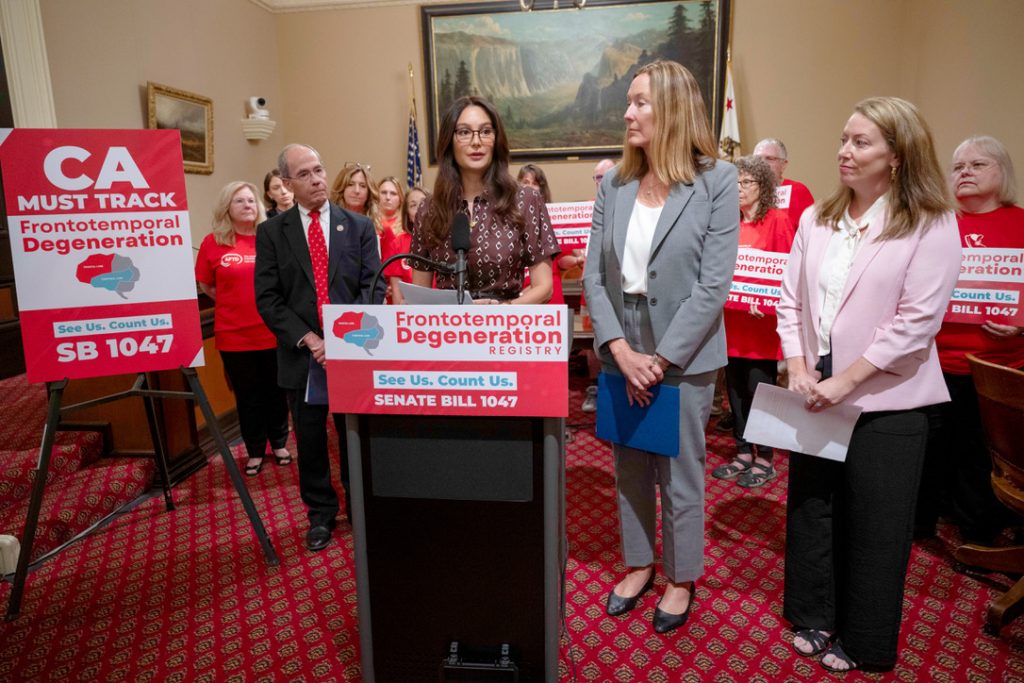
One of the things I will carry with me from this experience is just how powerful a community can be when we come together around a shared purpose. I’ve had the privilege of going to Sacramento alongside advocates and families who understand firsthand what FTD can take from a person and a family. The Association for Frontotemporal Degeneration (AFTD) has been there throughout this effort, helping educate lawmakers and giving our community a collective voice. I am incredibly grateful to Senators Roger Niello and Ben Allen, Assemblymember Jacqui Irwin, the many legislators and staff members who listened to our stories, learned about this disease, and helped move SB 1047 forward. This has also been bipartisan work, and I think that matters. Dementia does not care how you vote or what side of the aisle you sit on. Families facing these diseases need all of us.
And while SB 1047 is specifically about getting FTD counted in California, I believe what this effort represents is bigger than FTD. We hear the phrase “Alzheimer’s disease and other related dementias” all the time, but those “other dementias” have names. Frontotemporal dementia is one of them. Lewy body dementia, vascular dementia and many more. These are real diseases affecting real people and families, yet too often they can become lost beneath the larger dementia umbrella.
The effort in California builds on the trailblazing work by Senator Michelle Hinchey and New York State’s FTD community. They successfully passed the very first FTD Registry law last year. Both the New York and California laws show what can happen when a community comes together and says, our disease has a name, our families matter, we deserve to be seen and counted. I hope progress for the FTD community can also inspire and create momentum for others who have spent too long fighting to be recognized.
We have made it this far because families, advocates, researchers, lawmakers, and supporters kept showing up. Now we need everyone to show up one more time.
The California Legislature has done its part. SB 1047 now needs Governor Newsom’s signature. If you live in California or not, affected by FTD or not, I’m asking you to take a few minutes and add your voice to ours. Email the Governor directly at Leg.Unit@gov.ca.gov and respectfully urge him to sign SB 1047 into law.
Or AFTD has made it easy to contact the Governor through its Advocacy Action Center:
TAKE ACTION: Ask Governor Newsom to sign SB 1047
Let’s get FTD counted in California. Because being seen is the first step toward being understood. And being understood is how we move closer to better diagnoses, better support, treatments, and ultimately, a cure.
I sent my message. Hope it helps.
It absolutely will. Thank you
PleAse take the right action to supporT ftd . It should Be counted in california .
Thanking you for the opportunity to support, Emma. We’ve got this! I believe … and strongly. ♥️
I do too!!
Please count me in
Thank you!
Hope it helps
The support of the bill makes all the difference! Thank you.
Let’s get it done. A vital step for the ftd affected community.
If the shoe were on someone else you can be certain the funds would be rolling in across The Nation.
I admire all that youve been doing anD it will continue growing
My spouse has FTD. CAREGIVING IS A LOT. HOW TO GET HELP IS tough.
Keep up the great work emma. I very proud of you and how you’re taking care of your husband Bruce.
I know how difficult it can be at times.
I was a family caregiver to my mom and Dad over 8 years just in case, the book that I wrote is titled “when I Go Home by Bill Galea. It’s available at amazon.com and barnesandnoble.com. My book is primary about being the primary caregiver to my mom while she was going through alzheimer’s disease.
Also, I attended Montclair State while Bruce was a student there. I finally got to meet him in person when I saw him in “Misery” on Broadway. I talked to him for a minute or two and got to shake his hand. I mentioned to him 4 different people that we both knew while at Montclair state. I sent you a bunch of those photos previously on Instagram.
Hi Emma,
I’m happy to help you.
Sincerely,
Bill galeA
Hi Emma you are doing amaz things !!
Keep up the great work ☺️
You are doing an amaz job taking care of your hubby Bruce
Thank you for what you do
Please Tell Bruce hes my fav actir in the whole world!!