

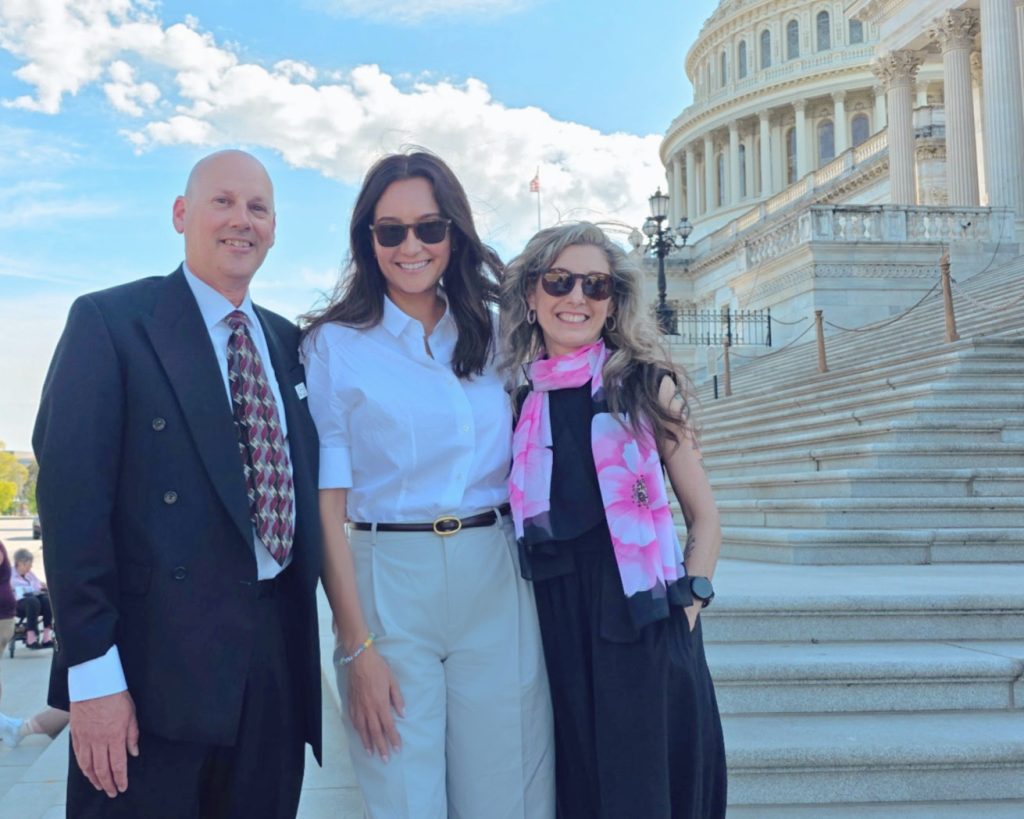
In April, I had the honor of speaking at the Association for Frontotemporal Degeneration’s (AFTD) first Capitol Hill briefing. I approached this opportunity with a profound sense of responsibility. I knew that when I stood before lawmakers, advocates, researchers, and families, I was not speaking only for myself, a person living with behavioral variant frontotemporal degeneration (bvFTD), I was advocating for the other individuals living FTD whose voices are often unheard. FTD affects each person differently depending on the variant, and every individual’s journey is unique. My story centers on the emotional and behavioral challenges I have faced while living with bvFTD.
I wanted to tell my story in a way that was raw, honest, and real. Too often, the realities of FTD are softened, hidden, or left unspoken because they are uncomfortable. Yet those difficult truths are exactly what must be understood if we are to create meaningful change. My goal was to represent people living with FTD authentically and to restore a sense of dignity to those of us who lose so much of it while battling this disease.
To accomplish that, I chose to share one of the most traumatic and undignified experiences of my journey. It was not an easy decision.
Before the briefing, I circulated my speech draft throughout the FTD community and asked for feedback. The responses surprised me. Many caregivers expressed discomfort with my speech. Their reaction was understandable. They have witnessed the devastation of this disease firsthand and often work tirelessly to protect the dignity and privacy of those they love. The story I shared exposed a painful reality that many families would rather not revisit, particularly when difficult decisions and misunderstandings may have contributed to the outcome.
But the response from people living with FTD was very different. They cheered on my words.
Again and again, I heard from individuals who told me that my story reflected experiences they had endured themselves. Many said they had never spoken openly about those moments because of the shame they carried or because they feared bringing embarrassment upon their families. What I had intended as my story quickly became something much larger. It became a shared story.
As my disease progresses, my world becomes increasingly confusing and frustrating. After diagnosis for years, I managed my crippling fear and anxiety through therapy, psychiatry, mindfulness practices, and exercise. I experienced occasional emotional breakdowns, but nothing my family could not manage.
My husband is a law enforcement officer. He has experience encountering dementia-related crises in the field. At least I thought he did—until the day I needed de-escalation in my own home.

There were a series of unfortunate events. Up until that point, my husband and I had followed a family safety plan developed by my psychiatrist and therapist. It worked well until, one day, it was not followed correctly. The result was the largest dementia-related psychosis episode I had ever experienced.
I knew something was wrong with me, but I did not know what. The fear was constant and overwhelming. I spun out of control because I felt overwhelmed and no one was listening to MY needs. In full disclosure, there are parts of that day I do not remember. But my feelings are valid. I was in a crisis. The emotional trauma I suffered will stay with me forever.
This particular day my fear became so overwhelming that I dialed 911. I told the dispatcher something very simple. “I do not feel safe.” “I am scared.” I called because I needed help. But instead of help, something else happened. I was violently arrested. I was humiliated in front of my neighbors. And then I was taken to the hospital and chained to a bed for five days. Five days. Why? Because no one in that hospital knew what FTD was. I was their first.
Think about that for a moment. A person with a degenerative brain disease called for help and ended up in chains because the system did not recognize her illness.
Today, I live with the aftermath of that experience. I am haunted by PTSD nightmares. I have developed a fear of law enforcement officers and emergency rooms. I struggle with new behavioral anxieties that did not exist previously. I now take medications I never needed before.
I believe that because I do not LOOK like what the general public imagines a dementia patient to be, my behavior was perceived as intentional malice rather than a symptom of a serious neurodegenerative disease.
Most painfully, the experience left me feeling abandoned by my family, friends, law enforcement, EMS personnel, healthcare providers, and my community. The details of that day still affect me- seeing my children’s faces when they saw me chained to a bed was the most painful detail.
The community services board counselor who arrived on scene with the police wore all black tactical gear. She had more tactical gear on her body than the actual police. My husband served on a SWAT team, so I recognized the appearance immediately. Later, I learned the word “counselor” was printed across the equipment. At the time, however, I was in crisis and she looked like a SWAT team member and I could not read words. Why did she have to present so militarized? There are ways to wear tactical gear to protect yourself under plain, pedestrian clothing.
I was terrified! The counselor who was there to “help me”- TERRIFIED ME.
Many people with dementia can become agitated when someone is dressed entirely in black. While I was experiencing psychosis, she appeared to me as a floating head with no body. Then suddenly, her hands and the police hands were on me.
I felt trapped. I felt cornered on my own front porch. It triggered the most intense fight-or-flight response of my life.
I still remember the pain in my wrists from what my husband later described as “hurt cuffs.” I was placed in a police vehicle alone, without my caregiver or an advocate. Because I am petite and weigh only 86 pounds, the seatbelt strapped tightly across my neck, triggering another panic attack.
I had no idea where I was going. I did not know who these people were. The fear was primal.
At the hospital, I was yelled at and restrained while begging for a social worker. I remember hearing, “Be quiet. Stop being mean.” I remember hearing words like “crazy” and “nuts” as staff discussed me after the first sedative failed to render me unconscious. Eventually, it did. Yet even amid that traumatic experience, there were moments of humanity.
Not every healthcare worker or law enforcement officer treated me poorly. Several veteran nurses openly questioned why I had been placed under a Temporary Detention Order (TDO). One explained that because I was younger than 60, I could not be transferred to a memory care unit. At the same time, psychiatric facilities repeatedly refused my transfer because they did not admit patients with dementia. The hospital and community services board had no idea what to do with me. Several police officers expressed concern about what was happening to me. They spoke openly with hospital staff and advocated on my behalf.
Ultimately, I was not released until I appeared before a judge and was able to explain that I had FTD. One officer even appeared with me and offered support. Once my diagnosis was understood, I was promptly released.
That experience changed me. But it also motivated me.
As I recovered, I reached out to my friend and volunteer partner, Carrie Edwards, AFTD’s Virginia Ambassador. Advocacy has always been a source of healing for me, and Carrie was exactly the person I needed. We had worked together on FTD legislation before. In fairness, Carrie does all the heavy lifting and executive functioning while I contribute the personal story.
Together, we began focusing on something that could prevent others from experiencing what I endured: EDUCATION.
According to Carrie, in 2024, Virginia passed House Bill 933, a significant step toward educating first responders about dementia and neurodegenerative conditions. The legislation requires training for emergency personnel to recognize cognitive impairment and respond appropriately. It includes communication strategies and scenario-based exercises designed to reduce escalation and improve outcomes.
A pilot program is currently underway in Richmond, VA, bringing together 911 dispatchers and local agencies to evaluate the effectiveness of this training before broader implementation.
This is an important beginning, but there is still work to do.
Future advocacy efforts should include expanding dementia-informed training into law enforcement academies and continuing education programs, increasing awareness of FTD-specific symptoms, developing protocols for wandering, language loss, impulsivity, and caregiver coordination, and incorporating these standards more broadly into criminal justice training frameworks.
Other states, including Arkansas and Florida, have adopted dementia-related training requirements, while states such as Ohio, Illinois, and Pennsylvania are pursuing similar initiatives. The momentum is growing.
Since my hospitalization, Carrie and I have participated in on-line trainings and educational presentations to help first responders, healthcare providers, and community members understand what a person with dementia may be experiencing during a crisis. Because what looks like aggression may actually be fear. What looks like noncompliance may actually be confusion. What looks like defiance may actually be a brain disease.
Looking back, I do not share my story because I want sympathy. I share it because I want change. I want the next person living with FTD who calls 911 to receive help instead of trauma. I want caregivers to know they are not alone. And I want families to prepare before a crisis occurs.
If your loved one is living with dementia, create a family safety plan with your therapist, psychiatrist, neurologist or healthcare team. Every family’s plan will look different. Mine now begins with contacting my psychiatrist before calling 911 whenever possible. Carry an awareness card that explains the diagnosis. Identify trusted contacts who can verify the condition. Encourage calm communication and avoid unnecessary confrontation. Most importantly, discuss transportation and crisis-response plans before they are needed.
The story I told on Capitol Hill was uncomfortable, painful and deeply personal. But sometimes the stories that make us the most uncomfortable are the ones that most need to be told. Because awareness begins with truth. And no person living with a degenerative brain disease should ever have to fear asking for help.
Thank for your story. I don’t have dementia but my former law enforcement spouse does. I had to call police on two occassions and yes. They were not equipped to handle dementia related delirium. My spouse does not have ftd, but I can relate to your story. I also found out and I under why nursing homes and assisted living facilities would not take an individual that had been “arrested” by the police. They considered him violent. So I brought him home and educated myself and caregivers I found about how to deal with delirium. It has been quite a journey! Still caring for him at home with help that I had to educate about the illness.
Thank you for your courage in telling your story. I coulnt agree with you more that serious EDUCATION is needed at all public service levels. I witnessed first hand similar behaviors. Delaware, too, is in need of change towards those with FTD/Ppa.
Thank You Natasha! It was a pleasure to meet you at the 2025 AFTD educational conference. you abd Carrie are using your voices and make an impact!!
I continue to advocate as my husband Frank has FTD and We have walked this Long journey for 11 years so far. The other part you mentioned is the discrimination from the Memory care / Asst living community . we were rejected 3 times for reasons of we dont take people with FTD or he is under 62! IT all falls on us to figure it out!